What encryption adds to a covert link
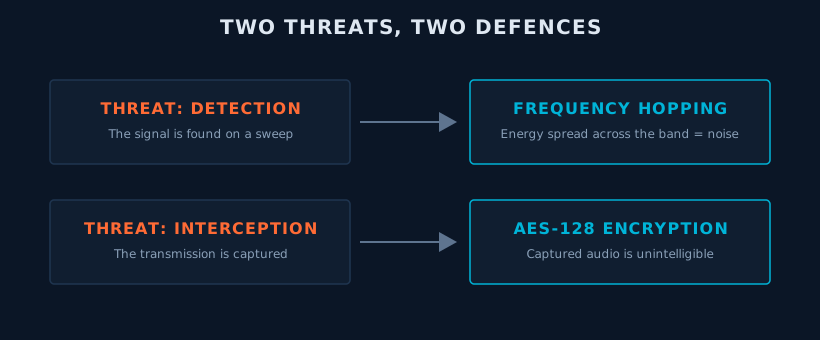
A covert audio transmitter that sends clear voice is exposed: anyone who tunes to the right frequency hears the conversation. Encryption changes the proposition entirely. The audio is scrambled before it leaves the device, so that even a perfect interception yields nothing but noise. The protection no longer depends on the adversary failing to find the signal — it holds even when they do. It is one of the two defining properties of a professional covert listening device, alongside frequency hopping.
What AES-128 actually is
AES, the Advanced Encryption Standard, is the symmetric cipher adopted by the US government and used worldwide to protect classified and commercial data alike. "128" refers to the key length: 128 bits. Both the transmitter and the authorised receiver hold the same key, the audio is encrypted with it on the way out and decrypted with it on the way in, and without that key the ciphertext is computationally infeasible to reverse. AES has been subjected to decades of public cryptanalysis and remains unbroken in practical terms.
What it protects
In a covert audio context, AES-128 protects the one thing that matters most: the content of the intercepted conversation. If a counter-surveillance team captures the transmission — whether by luck, patience or superior equipment — they are left with an unintelligible stream. They cannot recover the words, identify the speakers from the audio, or use the recording as intelligence. With paired-key operation, only an authorised receiver holding the matching key can make sense of the link, so even another identical device cannot eavesdrop.
What it does not protect
This is where honest engineering matters. Encryption secures content; it does not make a device invisible. AES-128 does not hide the fact that a transmission is occurring — the radio energy is still present and, in principle, detectable. It does not conceal the timing or pattern of transmissions, which can themselves be revealing. And it offers no protection against physical discovery: a device that is found and opened up is a device that is compromised, key and all. Encryption is one layer in a system, not the whole answer. This is precisely why it is paired with frequency hopping, which attacks the detection problem that encryption deliberately leaves alone.
Why 128-bit is enough
It is tempting to assume bigger is always better — that 256-bit must be twice as secure as 128-bit. In practice, 128-bit AES already places a brute-force attack far beyond the reach of any foreseeable computing capability; the number of possible keys is astronomically large. For a real-time covert audio link, the practical threats are not brute-forcing the cipher but key management, physical capture and detection — areas where the engineering effort is far better spent. AES-128 delivers robust, standards-grade security while keeping the processing load light enough for a small, low-power device to run it in real time.
Encryption and hopping together
The two techniques are complementary, and a credible covert audio system uses both. Frequency hopping makes the link hard to find and follow; AES-128 makes anything that is captured worthless. Remove encryption and a located signal can be heard; remove hopping and a clear-but-encrypted signal is easy to locate and flag, even if its content stays hidden. Together they protect against the two distinct failure modes of a covert link — being detected and being understood — which is why both are standard across the K9 range rather than optional extras.