The problem with a fixed frequency
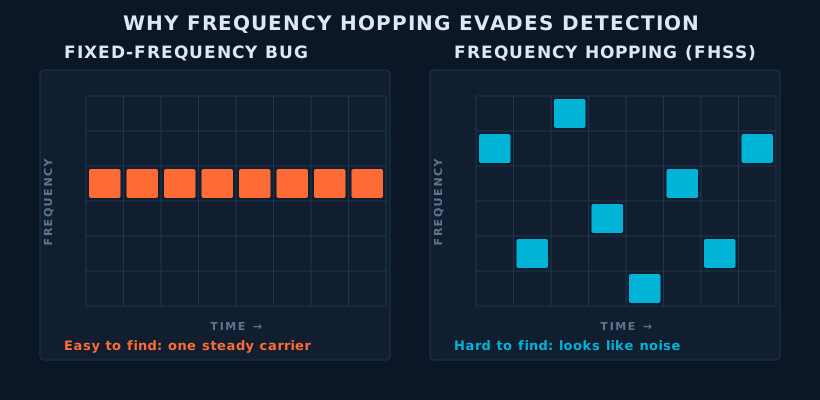
A conventional covert transmitter sits on one channel and stays there. That makes it simple to build and simple to receive — and equally simple to find. A counter-surveillance operator sweeping the radio spectrum is looking for exactly this: a steady, unexplained carrier sitting where it shouldn't be. Once located, the signal can be tuned in, listened to, and the device physically traced. A fixed-frequency bug effectively advertises its own position the entire time it is switched on.
What frequency hopping does
Frequency-hopping spread spectrum (FHSS) takes the opposite approach. Instead of holding one channel, the transmitter and its paired receiver agree a pseudo-random sequence of frequencies and jump between them many times a second — in the K9 system, around fifty hops per second. Both ends follow the same sequence in lockstep, so the link stays connected, but at any given instant the signal occupies a different slice of the band.
Why a sweep struggles to find it
To a counter-surveillance receiver, the result is not a tidy carrier sitting still to be measured. It is a series of brief, scattered bursts appearing and vanishing across a wide span of spectrum — less like a persistent single-frequency carrier than a conventional transmitter. A sweep that pauses on any single frequency catches, at most, a fleeting fragment before the signal has moved on. Without knowing the hopping sequence, an adversary cannot easily distinguish the device from the ordinary RF clutter of a modern building, let alone lock onto it long enough to decode or locate it. The energy is there, but it is spread so thinly across time and frequency that isolating it is a genuinely hard problem.
This is the difference in a single picture:
Resilience to jamming and interference
Avoiding detection is not the only thing hopping buys. Because the link is constantly moving across the band, it is also far more robust than a fixed channel. Narrow-band interference — whether ambient noise or a deliberate attempt to jam a known frequency — only ever affects whichever channel the system happens to be using for a fraction of a second. The transmitter and receiver simply hop past the affected channel to a clear one, and the audio link continues. A fixed-frequency device, by contrast, has nowhere to go: block its single channel and the link is dead. For a covert link that has to stay up through an entire operation, that resilience matters as much as stealth.
Coexisting in crowded spectrum
The same property makes hopping well suited to the cluttered RF environments where covert audio is actually used. Urban areas are saturated with cellular traffic, Wi-Fi, Bluetooth and two-way radio, and a fixed-frequency device parked on a busy channel quickly loses frames to collisions. A hopping link spends only a moment on any one frequency and steps through the congestion, picking its way between other users' transmissions rather than fighting them for a single channel. In practice that means a cleaner, more reliable feed to the operator in exactly the dense environments where a fixed link degrades.
Hopping is not the same as encryption
It is worth being precise: frequency hopping protects against detection and interception, not against understanding. Hopping makes the signal hard to find and hard to follow. Encryption makes the content meaningless even if it is captured. They solve different problems, which is why a serious covert audio device uses both — FHSS so the link is hard to detect, and AES-128 so that anything an adversary does manage to capture is unintelligible. Relying on hopping alone would mean that a determined, well-equipped opponent who reconstructed the sequence could still hear everything.
What frequency hopping does not do
No technique is a magic cloak, and it is dishonest to pretend otherwise. FHSS reduces the probability of detection; it does not reduce it to zero. A patient operator with wideband capture equipment and signal-analysis tools can, given time and the right conditions, identify that something is hopping. The device still emits energy, and energy can in principle be found. What hopping buys is margin — it raises the cost, skill and time required to detect the link far above what a routine sweep can deliver, and against most real-world counter-surveillance it is the difference between being found and not being found.
Where it matters operationally
The value of hopping scales with the capability of the opposition. Against a casual check it is almost certainly decisive. Against a professional technical surveillance counter-measures (TSCM) team it raises the bar substantially and buys time. For users whose work assumes the subject may run counter-surveillance — which describes most law enforcement and agency deployments — a frequency-hopping link is not a luxury feature but a baseline requirement. It is the reason commodity fixed-frequency bugs are unsuitable the moment the stakes rise.
This is why every device in the K9 range hops, and why hopping and encryption are paired rather than offered as alternatives.